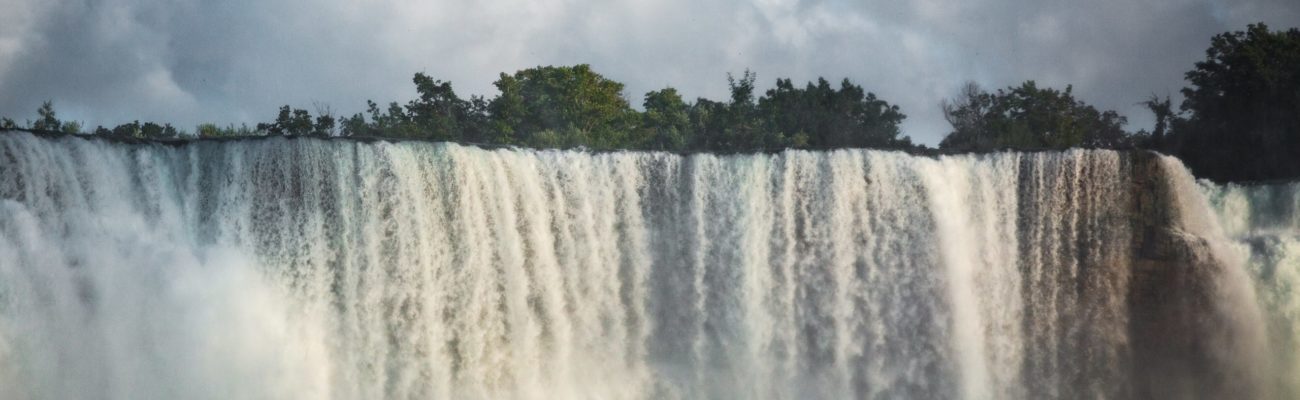
Hon. Peter Harder: Honourable senators, I rise to participate in the inquiry commenced by our colleague Senator Sorensen on the nation-building value of tourism. I do this later in the day when I know you’re anxious to begin your own weekend tourism. I would like to speak about my home area, the Niagara Peninsula, because it ought to be referenced in any commentary on tourism in Canada. Of course, you all know Niagara Falls.
One thing that has surprised me over the years is the lack of geographic comprehension as to where Niagara Falls is. You might remember, in the 2000 campaign, the then Leader of the Opposition had a campaign event in front of the falls, and he said that they were terrific falls that fell from Lake Ontario to Lake Erie, going exactly in the opposite direction.
The Niagara Peninsula, of course, is a peninsula. To the south is Lake Erie, to the north is Lake Ontario and to the east is the Niagara River. You travel east to go to the United States. It is a territory that was very much a part of the defining events of our country.
The American Revolution led to a significant exodus of the United Empire Loyalists, first to the Niagara Peninsula and then to what was called Berlin, which is now Waterloo-Kitchener. The War of 1812 had battles fought on the soil of the Niagara Peninsula. Brock’s Monument and Fort George, which was the bastion of support, are there, and we have the trail that Laura Secord walked with her cow in front of her to pass through the American enemy lines to alert the British that were protecting our country. So we have a keen sense of where it is but not always an understanding of what is all around there.
You’ve all been to Niagara-on-the-Lake, I’m sure, and some of you have been to the Shaw Festival. You’ve been to the falls and taken the Maid of the Mist, perhaps, and participated in various tours and the like.
I want to tell you that this region welcomes more than 13 million visitors each year, generating almost $4 billion in visitor spending and contributing about $1.4 billion in GDP — 6.5% of the region’s economy is tourism. It sustains nearly 4,400 tourism-related businesses and 36,000 jobs. Tourism isn’t just a visitor economy. It’s a driver of jobs, small businesses, agricultural sustainability and rural prosperity.
As important as the eastern end of Niagara is — the anchors being Niagara Falls and Niagara-on-the-Lake — I want you to stop short of getting there and go off the Queen Elizabeth Way a little earlier. Take Christie Street in Grimsby or Ontario Street in Beamsville or, best yet, Victoria Avenue in Vineland. Go through the rural areas of my home community, which is Lincoln.
The Town of Lincoln is only some 50 years old as a town, but it’s amongst the oldest settlements certainly in Upper Canada, which includes the little hamlets of Vineland, where I grew up, and Jordan which is famous for its revived tourism sector, which I’ll get to. It has the Town of Beamsville. It’s got the little hamlet of Campden. It came together as a result of the amalgamation some 52 years ago into the Town of Lincoln. Why Lincoln? Because it’s actually the residual name of the County of Lincoln, which was the historic county on the northern half of the Niagara Peninsula.
The Town of Lincoln has also been rebranded in some fashion as a tourist destination for what they call the Niagara Benchlands, with benchlands being the distinct stepped architecture of the landscape. As you drive around the peninsula, you have the escarpment on your south side and a series of ledges, which host increasingly tender fruits and wine. The benchlands have the largest concentration of craft beverage producers in Canada, which includes breweries, cideries, distilleries and, of course, wineries.
The Town of Lincoln, with some 23,000 people spread over this territory between Grimsby and St. Catharines, has over 50 individual wine labels, most of them family-related businesses. Their wines are both regionally and internationally known. There are award-winning wines, like Hidden Bench Estate Winery, Westcott Vineyards and Vineland Estates Winery — three of my favourite wines. I would invite you to go to the restaurant at Vineland Estates up on the bench. On a clear day, sip a glass of wine and look across the lake to Toronto and say, “Aren’t you glad you’re not in that traffic?”
These wines are not the same as those in the Niagara-on-the-Lake area, which are further east. Wines from this microclimate are influenced by ancient limestone and glacial drift, giving them their signature minerality and complexity, which are perfect for Rieslings, Cabernet Francs, Chardonnays and icewines.
After a long day of sampling wines from across the region, a dinner at Restaurant Pearl Morissette may be in order — assuming you have a reservation. This exquisite fine dining experience is internationally recognized with two Michelin Stars, one of only two restaurants in all of Canada with this distinction. Moreover, it also has a Michelin Green Star, a relatively new designation for restaurants recognized with a Michelin Star and that are also at the forefront of sustainability and eco-friendly gastronomy. Restaurant Pearl Morissette is the only restaurant in the country holding both two Michelin Stars and a Michelin Green Star.
According to the Michelin Guide, a two-star designation means excellent cooking that is “worth a detour.” So take that detour off the Queen Elizabeth Way.
Tourism and hospitality support more than 1,700 jobs in the Niagara Benchlands with employment driven by these craft beverage producers and restaurants but also in the sectors of accommodation, agri-tourism, cultural and visitor and outdoor experiences, with the Bruce Trail being one.
Tourism is a key driver of rural prosperity in the Town of Lincoln, with visitor spending supporting local businesses, farms, wineries and local producers. Tourism helps to preserve local agricultural heritage and protect the rural landscapes that define my community.
As I alluded, in order to understand the nation building of tourism, we must also understand a bit of our history and where we come from. Through the Lincoln Museum & Cultural Centre in the village of Jordan, the stories of Lincoln’s cultural, social and agricultural heritage are preserved through exhibitions, educational programs and world-class archives in its basement. The Lincoln Museum & Cultural Centre acts as a heritage hub for the Town of Lincoln and offers intimate tours of the Fry House and the Jordan Schoolhouse.
The Fry House is a two-storey log dwelling built around 1815 by two German-speaking Mennonite settlers from Pennsylvania. It was a family home until 1892. In later years, the house was used as a chicken coop and a playhouse. Originally situated in Vineland, the house was carefully moved in 1959 to its current location on the Lincoln Museum & Cultural Centre property. The Fry House is a rare surviving example of the Pennsylvania Dutch traditional architecture in Canada.
The Jordan Schoolhouse is a one-room school that served the children of Jordan for almost 90 years. Inside, students would learn moral instruction, hands-on skills and, of course, the three Rs. As many as 60 children, ranging from ages 6 to 16, would be taught by a single teacher in one room, putting even Ontario class sizes of today to shame. The school was closed in 1948 and subsequently purchased and returned to the community, where it was opened as Jordan’s first museum. The schoolhouse was later restored to reflect a classroom circa 1908.
Beyond Jordan, the Town of Lincoln is home to a collection of historic villages and hamlets, to which I already referred. I know that Senator Black visited the area last weekend. It was all the news in the town. He participated there in the unveiling of a statue to honour the Farmerettes, which reflects its agricultural roots. The Beamsville high school is where I went to high school, and the community remains rich in culture and heritage, having benefited from major waves of immigration over the years.
I’d also like to point out that Lincoln celebrates and honours the history of the Attawandaron — or the Neutral Nation — the first known inhabitants of the land. Developed in collaboration with Indigenous partners, Sho’aríshon Park — which was recently opened — features permanent and evolving public art, a rain garden with native species, interpretive elements and gathering spaces that foster learning, reflection and connection to the area’s Indigenous heritage. The community is keen on celebrating its Indigenous history. Oral histories and archaeological evidence suggest Indigenous presence in the Niagara Region for at least 13,000 years. The name of one Neutral group, the Onguiaahra, is believed to be part of the origin of the word “Niagara.”
Through its museums, parks, heritage properties and cultural programming, the wonderful Town of Lincoln celebrates the stories of all its peoples. Agriculture and communities have defined the Niagara Benchlands for generations. Nation building isn’t just a modern philosophy; it’s what humans have always done. In Niagara and in the Town of Lincoln, our nation-building past has helped create a stepping stone for nation building now, which will help future generations create more steps into the future.
The value of tourism should not be understated for all the Niagara Region. Tourism is where Canadians learn about their home, their history and how to preserve their country in all of its glories and regional dimensions.
I encourage Canadians to learn more about all the regions of Canada. Surely, when you’re thinking of going to Niagara Falls next, get off the road at Christie Street, Ontario Street or, best yet, Vineland and Victoria Avenue. Thank you, colleagues.
Hon. Senators: Hear, hear.
Hon. Peter M. Boehm: Would the senator take a question?
Senator Harder: Absolutely.
Senator Boehm: Thank you very much, and thank you for that interesting statement, Senator Harder. I am asking you whether there’s any truth to Beamsville originally being Boehmsville, in the best of senatorial spelling, founded by Jacob Boehme — Beam — who was a cousin of James — Jim — Beam, the Kentucky distiller whose product we no longer drink. Is this true?
Senator Harder: Thank you, Senator Boehm. It is true, and these Beams were much quicker at integrating and recording their name change to reflect an easier read than yours.